
📊 Cracking the Code of the Commodity Channel Index (CCI) 📈
Mastering Momentum for Smarter Options Trading

Hey traders! 👋
I hope you’re all doing well and ready to dive into another essential tool in our options trading arsenal. Today, I’m going to break down the Commodity Channel Index (CCI) and see what makes it tick. If you've ever wondered how to spot those golden opportunities in the market, the CCI might just become your new best friend.
What Does the CCI Indicator Tell You?
So, what exactly is this CCI thing? The CCI is a momentum-based oscillator that helps us identify overbought and oversold conditions in the market. In simpler terms, it gives us clues about when a stock might be due for a reversal or when it's likely to continue its current trend. Imagine it like a radar, picking up signals that could mean a shift is coming. 🚦
When the CCI rises above 100, it suggests that the asset is overbought, potentially signaling a pullback. On the flip side, when it dips below -100, the asset might be oversold, hinting at a possible bounce. The key here is potential—nothing is ever guaranteed in the markets, but CCI gives us a solid heads-up.
Is CCI a Good Indicator?
Now, you might be wondering, "Is CCI reliable?" The answer is a resounding yes—but with a catch. Like any tool in trading, the CCI isn't foolproof on its own. It's most effective when combined with other indicators, like moving averages or trend lines, to confirm the signals it gives you.
Think of it like this: The CCI is a great detective, but even the best detectives work better with a team. 🔍 So, while the CCI can definitely enhance your trading decisions, I wouldn’t recommend relying on it as your sole source of truth.
What’s the Best Setting for a CCI Indicator?
Here’s where things get a bit subjective. The default setting for the CCI is 14 periods, which works well for most traders. However, if you’re more of a short-term trader, you might want to experiment with a 10-period CCI to catch quicker moves. For those with a longer horizon, a 20-period CCI could smooth out some of the noise.
Remember, there’s no one-size-fits-all answer here. My advice? Test out different settings on your preferred stocks and see what feels right for your strategy.
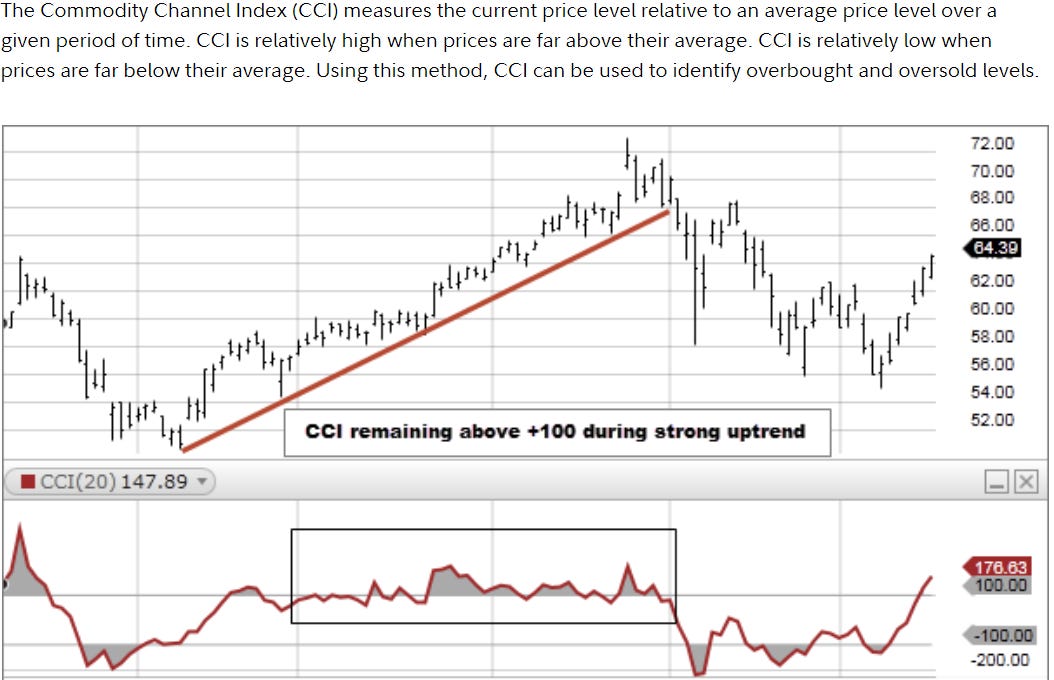
How to Use CCI Indicator for Options Trading
Alright, let's get into the juicy part—how to actually use the CCI in your options trading. Here’s a simple yet effective strategy:
Identify Overbought or Oversold Conditions: Use the CCI to spot when a stock is overbought (above 100) or oversold (below -100).
Confirm with Other Indicators: Pair the CCI signal with another indicator, like the Relative Strength Index (RSI) or Bollinger Bands, to confirm the move.
Choose Your Strike Price: If the CCI suggests the stock is overbought and a reversal is likely, consider buying put options or selling covered calls. If the CCI indicates oversold conditions, buying call options or selling cash-secured puts could be the play.
Set Your Expiry: Align your options expiry with the timeframe you’re trading on. For a short-term move, you might go with weekly options. For a longer trend, consider monthly expirations.
Commodity Channel Index vs. Stochastic Oscillator
You might be wondering how the CCI stacks up against the Stochastic Oscillator—another popular momentum indicator. Both are great, but they have different strengths:
CCI: Better for spotting strong trending conditions. It’s like a spotlight on potential breakouts or breakdowns.
Stochastic Oscillator: More sensitive to small price movements and often used to catch quick reversals in ranging markets.
If you’re trading in a strong trending market, CCI is your go-to. If the market is more choppy or sideways, the Stochastic Oscillator might give you more precise signals. 🚀
Limitations of Using the Commodity Channel Index
No tool is perfect, and the CCI is no exception. Here are a few things to keep in mind:
False Signals: The CCI can sometimes generate false positives, especially in choppy markets. It’s essential to use it in conjunction with other indicators.
Lagging Indicator: Like most momentum indicators, the CCI can lag behind the actual price action, which means you might not catch the exact top or bottom.
Not Ideal for Range-Bound Markets: The CCI shines in trending markets but can be less reliable when the market is stuck in a range.
My Take
At the end of the day, the Commodity Channel Index is a valuable tool for those of us looking to fine-tune our entry and exit points in options trading. It’s not the be-all and end-all, but when used wisely, it can significantly improve your decision-making process.
In fact, the CCI is the first tool I use in my scans to identify options opportunities and assess the strength of a trend. I measure this on a scale of 1-10, with 10 being the strongest bullish candidate and 1 being the strongest bearish candidate:
1-3: These are weak stocks, generally in a bearish trend, and are potential sell candidates.
4-6: Stocks in this range lack any strong trend and exhibit weak momentum—often a sign to stay away.
7-10: These are strong stocks, typically in a bullish trend, and are potential buy candidates.
After identifying these opportunities with the CCI, I then use other tools and the Greeks to narrow down my choices further.
Give the CCI a spin, and see how it fits into your trading strategy. As always, feel free to reply with your thoughts or questions—I love hearing from you! Let’s keep learning and growing together. 💪
Happy trading!-ec
*Disclaimer: The information in The Options Oracle is my opinion, not financial advice.
Looking For More Trade Ideas? Check Out My Twitter/X EdwardCoronaUSA
So it doesn’t work well in identifying over bought or oversold conditions in ranging markets. The stochastic is better for that. It’s a decent trend indicator though?